When you are working at the terminal long enough, you hit a wall with traditional text editors. While Nano is safe but restricted, Vi and Vim are powerful yet require a steep learning curve. I was wishing for a terminal editor that behaved more like modern editors but still lived entirely inside the terminal, and then became increasingly tired of being an “older” person. Fresh was interesting to me because that’s what I liked about the .”
Rust has written an open-source, terminal based text editor called Fresh. It carries many of our love for modern graphical editors, including familiar shortcuts, mouse support and an intuitive interface, which enter into the terminal. Fridge is a focus on ease of use and discoverability for rather than using modal editing or memorizing command sequences, instead of the latter. I have a chance to start working right away and you can open it.
Key Features of Fresh
Let us take a look at the specific features that make the Fresh text editor such a useful Linux tool.
Unlike traditional editing,* Fresh allows users to start working immediately without learning modes or special command syntax. In a case where you can highlight text and copy it with Ctrl + – C, or paste it at another location using ‘CctRlo+.V’.
- It includes an integrated terminal pane, enabling both editing and command execution within a single interface.
- The editor supports direct pointer interaction, allowing precise cursor placement, text selection, and smooth scrolling with your mouse.
- It embeds a directory navigator (File explorer) that allows users to find, open and manage files without returning to the shell.
- Fresh supports flexible layouts with split views, pane orientation controls, line wrapping, line numbers, and theming for personalized workflows.
- The editor can render Markdown content inline, making it suitable for writing and reviewing documentation.
- It uses a internal text handling model designed to edit very large files efficiently without loading the whole file into memory at one time.
It also provides advanced editing capabilities like deep undo and redo history, multi-cursor editing, column selection, smart indentation, comment toggling, and system clipboard integration.
The features such as go to line, bracket matching, word-based movement (position history), bookmarks and jumping directly to language server-reported errors allow for precise navigation with * Fresh. - Search and replace is powerful and responsive, supporting incremental search, regular expressions, selection-scoped operations, and fast project-wide searches.
- Keyboard macros allow you to record and replay repetitive editing actions, improving productivity during repetitive tasks.
Using features like “repository status in file navigation” and an image-based Git log viewer for the inspection of history, * Fresh integrates with GiT features such as ‘Resource management is available to display repository status on file Navigation.
TypeScript is a sandboxed plugin system that allows for customization of * The editor can be extended using Typescript, while keeping extensions isolated from the core editor.
Installation and Getting Started
The official repositories of most Linux distros have not yet released fresh, but this is an efficient and fast install script that automatically detects your system by itself and chooses the best way to do it. So, this gives you a stable setup with the latest features straight out of upstream.
To install Fresh using the recommended quick method, run this command:
curl https:

//

raw.githubusercontent.com

/

sinelaw

/

fresh

/

refs

/

heads

/

master

/

scripts

/

install.sh

|

sh
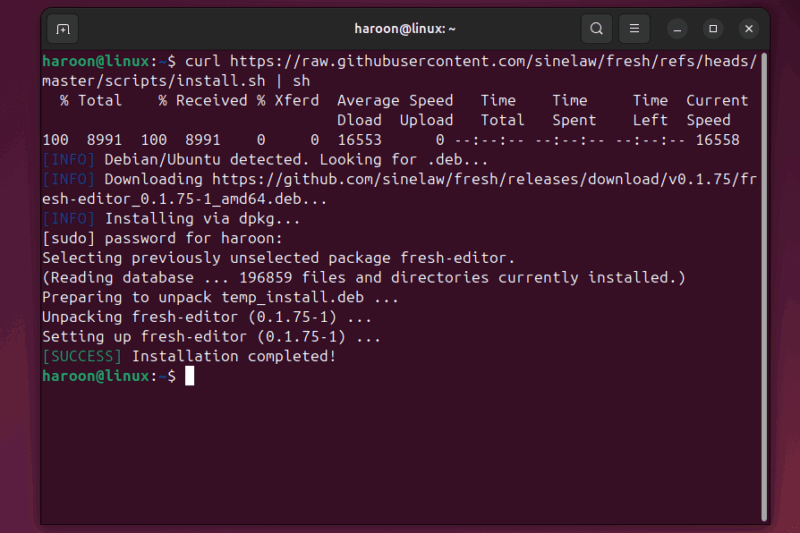
Additionally, if you have the Rust toolchain installed, you can install it via Cargo for access to the latest version.
cargo

install

fresh-editor
On Arch-based systems, the binary package from the AUR is recommended for faster installation:
yay

-S

fresh-editor-bin
The installation guide on GitHub is available for further installation details, and you can see the installation manual. There are also portable alternatives such as AppImage and Flatpak, which can be used with s.
You can launch Fresh directly from your terminal after you install it on your system using any preferred method, if you type.
fresh
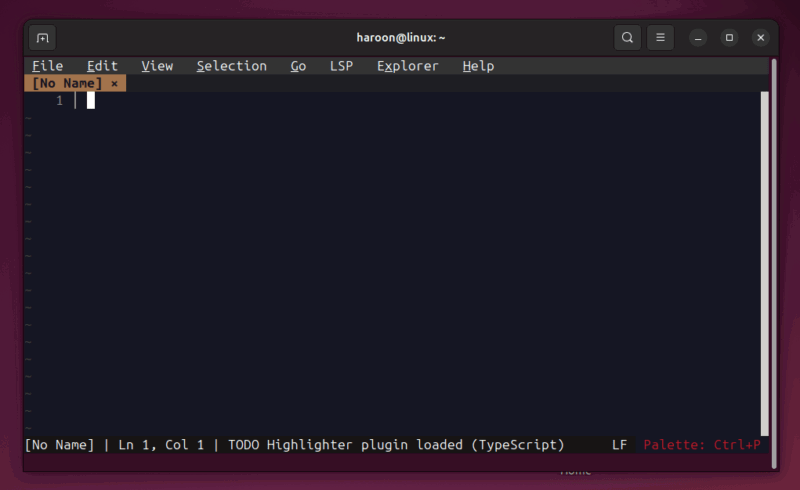
It opens instantly in your terminal with a clean, intuitive interface that is clean enough to make it easy for s to open. This allows for running this “You can also run Fresh with a particular file, too,” Further.
fresh filename.txt
You can open Fresh first, then load files using the File menu (or the built-in file browser) or the underlying file. Fresh displays the file in a tabbed interface once it is open, so you can work on multiple files simultaneously.
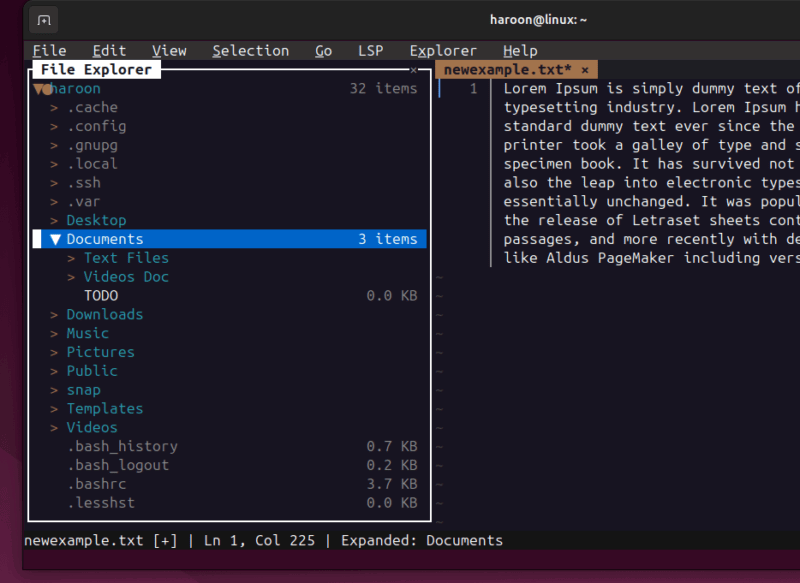
A wide range of programming and markup languages can be paired with syntax highlighting. Many cases where the file type is automatically detected by Fresh, which uses highlighting with no further configurations. You can manually enable or change the syntax mode from the menu if needed by .
Fresh vs. Traditional Terminal Editors
For many Linux users, traditional editors like nano, Vi and Vim have long been the standard tools of choice for a number of people using traditional editor. But for Linux beginners, these editors can be unintuitive and have a steep learning curve. This is a simple nano editor, for example, which has limited functionality and low extensibility (such as simplicity) with minimal extensibleness. Vim, which uses modal editing and is highly effective for experienced users but hard for newcomers or occasional user, has been then there.
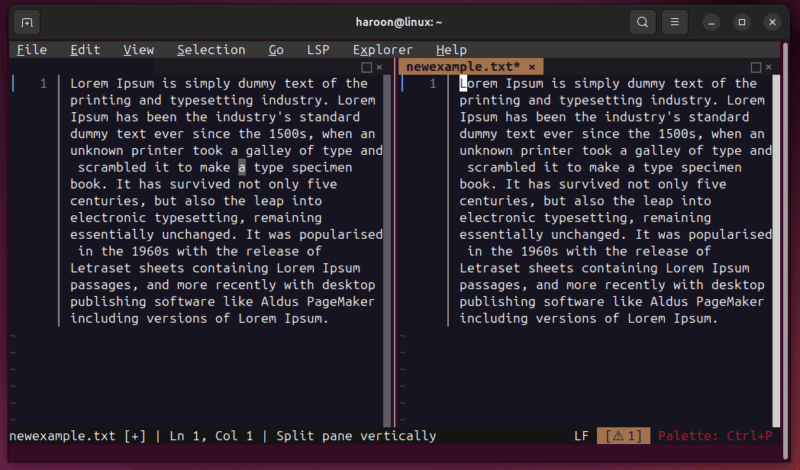
In another way, Fresh avoids modal editing entirely and uses familiar editing behaviors found in graphical editors. Instead of memorizing modes and command sequences you can use standard shortcuts, menus or a command palette for text interaction instead of the usual commands. This reduces the learning curve and makes features easier to find without external documentation.
Do you think it’s a bad idea to be phrasing; if you have spent ten years learning Vim, then Fresh may not be for you. In addition to being a match for highly customized modal workflows and plugin ecosystems, Vim is still the only one that remains unmatched. Fresh instead focuses on providing a modern, ready-to-use experience inside the terminal. Unlike full graphical editors, it bridges the gap between lightweight terminal editor and full-time editing without trying to completely replace either.
Final Thoughts
With a preference for modern editor conveniences, and features such as file explorers split views (and LSP support) without switching to gui editors that don’t require the use of fresh. Give Fresh a go for the . Download it with your current text editor; after a while, you may switch to it. However, Fresh isn’t just the choice; you can also try other Linux-based text editors.
Thanks for reading Fresh Adds an Easy-to-use and Powerful Text Editor to the Linux Terminal
