Although there is an extensive list of diagnostic tools available for Windows, it’s often overlooked by its most underrated counterpart the Reliability Monitor. If you’ve ever wished your PC had a “health score” that shows you exactly how it’s doing, this is the case. Let’s see how this simple tool can help you identify PC problems and keep your system running smoothly.
Reliability Monitor is a Powerful Diagnostic Tool
A powerful diagnostic tool like Reliability Monitor provides a visual timeline of your PC’s stability, tracking software/hardware crashes, system-level changes and system updates. For regular users, think of it as a simplified version of Event Viewer that provides an executive summary of PC problems.
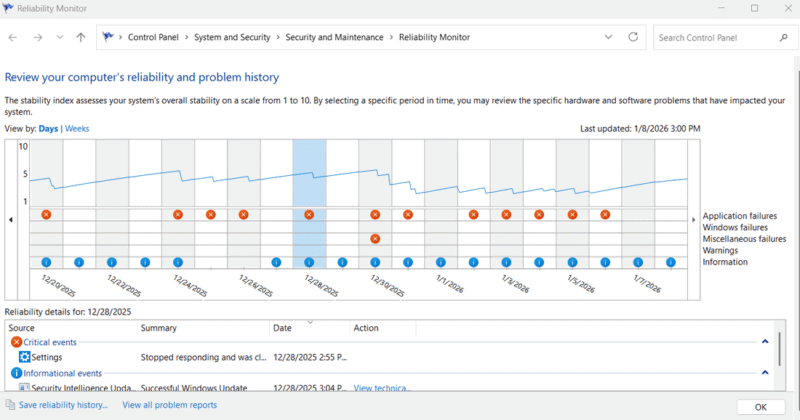
Although part of Windows since the Vista era, it has always been an unknown tool inside the Control Panel behind several menus is hidden inside its control panel. Now that Windows 10/11 has moved away from the Control Panel, this tool is even more obscure now.
I think it’s great to find the reason for a problem quickly when you have an issue. And, more importantly, it gives your PC a reliability score according to recent events so that you can keep track of overall PC health.
Accessing the Reliability Monitor
The Control Panel is deep buried in Reliability Monitor. To get it, you’ll have to open the Control Panel and go to System and Security Security and Maintenance. Click View reliability history button and open the Maintenance drop-down menu here.
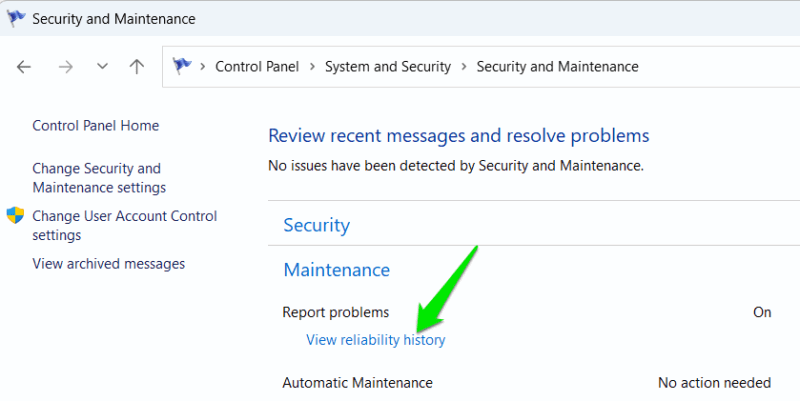
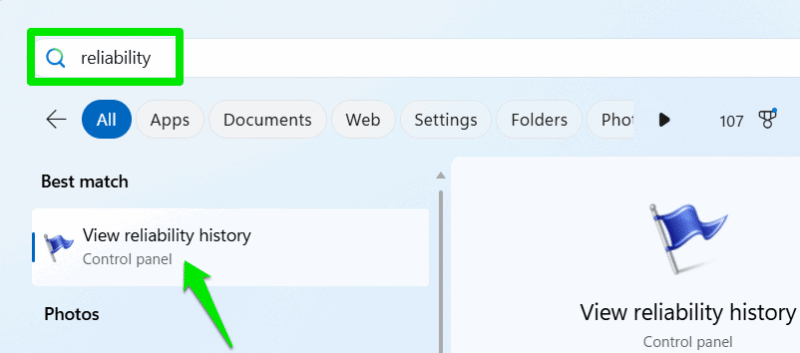
While that’s its official location, there are also more effective ways to get it. It would be easiest to type ‘reability’ in Windows Search, and click on the View reliability history control panel item. In the Run dialog you can also press the Wind + (R) keys, as well as type of ‘perfmon and/rel’ to open it.
In the future, if you’ll be using this tool often, you can also create a custom desktop shortcut and place perfmon /rel as its location.
Deciphering the Reliability Monitor Graph
The graph shows the state of each day on Reliability Monitor’s graph, which tracks PC events over the last 28 days. A blue score line and event icons are two major components of the graph a blue mark line. below is the meaning of both.
The Blue Score Line
The score is 0-10, which means a blue line on the graph’s y-axis. Days of stability/instability, this is your PC stability score (based on days of overall PC instability). The line is based on the latest events, and it goes up or down according to its weighted moving average (i.e.
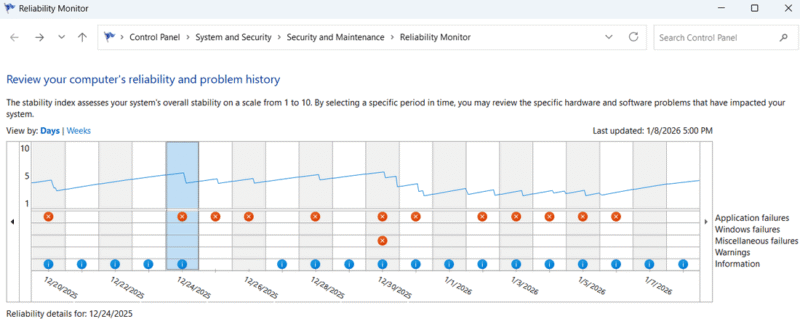
The 10 score isn’t realistic, as a working PC will always make minor errors and app crashes. Most users have a 5–7 score for the score, with 8 being excellent. If the blue line is consistently below 4 score, **You should be worried. It is usually a chronic problem such as ‘failing driver, corrupted files or hardware problems’ (typically **).
The score is a bit worrying, as in my case it is 4 to 6. That’s because of a problem with the QuickLook app that generates ‘critical error report every time I manually close it, but not ? So I don’t have to worry about anything like .
The Event Icons
Three icons are used to monitor health a red ‘X’ for critical events (crashes), – yellow ‘!’ warning, and -. The severity of these are then divided into horizontal rows to help you distinguish between a minor software glitch and – in some cases, if any major system failure.
Your stability score is based mostly on critical events, but warnings can cause slight drops in the score. Although information events are unbiased, they should be very important to understand why a critical incident occurred. If you have read a log that says “driver update or app installation immediately before critical error” (e.g.
Learning More About Errors
While the graph is stable at a glance, details section below gives information about what to do. If you click any day on the graph, all events from that date are shown by clicking it time, type and a short summary.
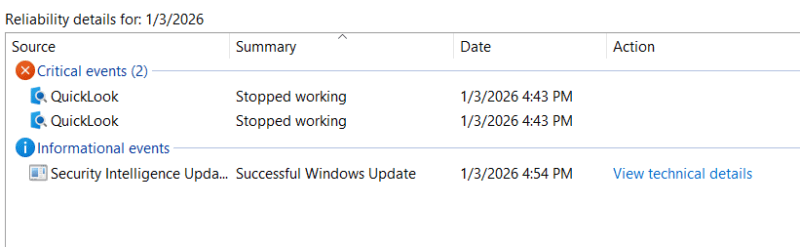
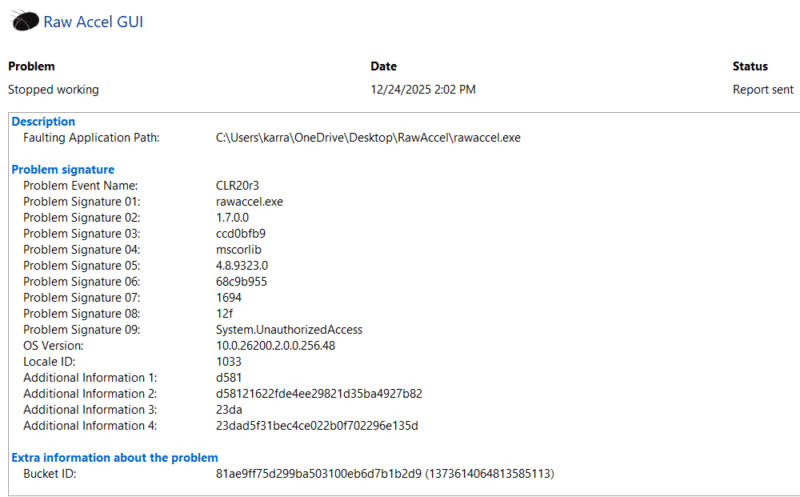
Scroll down View technical details next to an entry for a deeper dig. It also displays specific error codes (such as Exception Codes) that caused the crash, and is displayed in this page. ACopy (shortboard button) can easily paste these details into a search engine or an AI chatbot to find if there is.
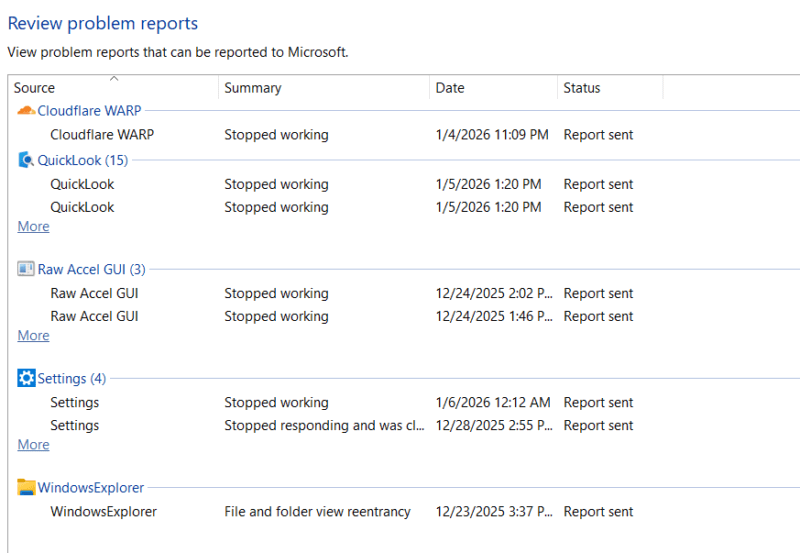
In a final, the View all problem reports button organizes every recorded issue into an organized table of sortable problems. That means that it is easy to spot apps which repeatedly causing problems, such as . In addition to the fact that you’ve recently fixed your PC and want a new start, the Clear all problem reports button will erase the history and reset the Reliability Monitor.
Generally speaking, Reliability Monitor can be an excellent way to look at your PC’s stability report from a single point of view. To see the full picture, just make sure you correlate errors with your overall score. These Windows system diagnosis commands can be used to start the repair process if you see that the Reliability Monitor has deep system issues.
Thanks for reading Use Reliability Monitor to Troubleshoot Your Windows PC
